



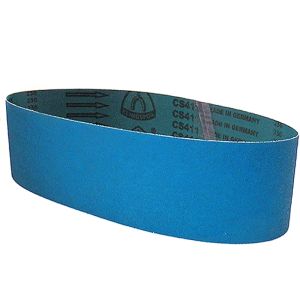
80 Grit Alumina Zirconia (Blue) Sanding, 4 in. Wide x 24 in. Long
Alumina Zirconia (Blue) Sanding / Planing Belt
Heavy-Duty Belts for Fast Stock Removal
These Alumina Zirconia sanding and planing belts are designed for heavy stock removal and demanding dimensioning applications. They are ideal for grinding stainless steel, spring steel, titanium, and other hard steels, as well as dimensioning wood. They can also be used for aggressive stock removal on plastic, rubber, glass, stone, and concrete products.
Specifications:
- Alumina Zirconia (AZ) Grain – Very hard and sharp abrasive grain designed for high-performance stock removal and extended abrasive life.
- YX Weight Backing – Lightweight polyester backing that provides excellent durability while remaining suitable for demanding applications.
- Closed Coat – Provides consistent abrasive coverage for efficient cutting and material removal.
- Resin-to-Resin Bond – Durable construction designed to withstand demanding sanding and grinding applications.
- Wet or Dry Use – Polyester backing is naturally resistant to water, making these belts suitable for wet or dry applications.
- Sold Individually
Alumina Zirconia (AZ)
Alumina Zirconia combines key characteristics of Aluminum Oxide (AO) and Silicon Carbide (SC) to create a durable yet friable abrasive grain. Like Aluminum Oxide, AZ is primarily made from bauxite, while its friable nature allows the grain to continually expose fresh cutting edges as it breaks down under sufficient machine pressure.
Proper pressure is important when using Alumina Zirconia. Without enough pressure to fracture the abrasive grain, the surface can glaze, reducing cutting performance and abrasive life. When used correctly, AZ provides a consistently sharp cutting edge along with excellent durability, making it particularly effective for high-removal applications where productivity and abrasive life are important.
Alumina Zirconia is commonly used for wood planing, heavy metal grinding, and other dimensioning applications. It is typically paired with durable paper or cloth backings. Because AZ is more costly to produce than conventional abrasives, it provides the greatest value in aggressive removal grits, typically from 24 through 60 grit.
Cloth Backing
Cloth abrasive backings are available in several basic weights, including J, X, and Y. J and X are cotton-based materials. In contrast, Y backings are polyester or, in some cases, a polyester/cotton blend.
- J Weight – A lighter cotton backing with some flexibility and conformability. It is suitable for applications where the abrasive needs to follow the workpiece to a limited degree.
- X Weight – A heavier cotton backing designed for general-purpose belting applications, including portable, intermediate, and wide belts.
- Y Weight &ndash
| GRIT # or COARSENESS | 80 |
|---|---|
| BRAND | Klingspor |
| MATERIAL | Alumina-Zircona |
| WIDTH | 4 in. |
| LENGTH | 24 in. |
| QUANTITY | (1) Each |
| SKU | KP-424E |
| Prop 65 |
|
 Warning: Some dust that is created by power sanding, sawing, grinding, drilling, or other activities contains chemicals known to the State of California to cause cancer, congenital disabilities, or other reproductive issues. These chemicals include Lead from lead-based paints, crystalline silica from bricks, cement, and other masonry products, and arsenic from chemically treated lumber materials. Your risk from exposure to these chemicals varies, depending on how often you do this work. To reduce your exposure, work in a well-ventilated area and with approved safety equipment, such as dust masks and dust collection specifically designed to filter out microscopic particles. For more information go to www.P65Warnings.ca.gov/wood.

Login and Registration Form