

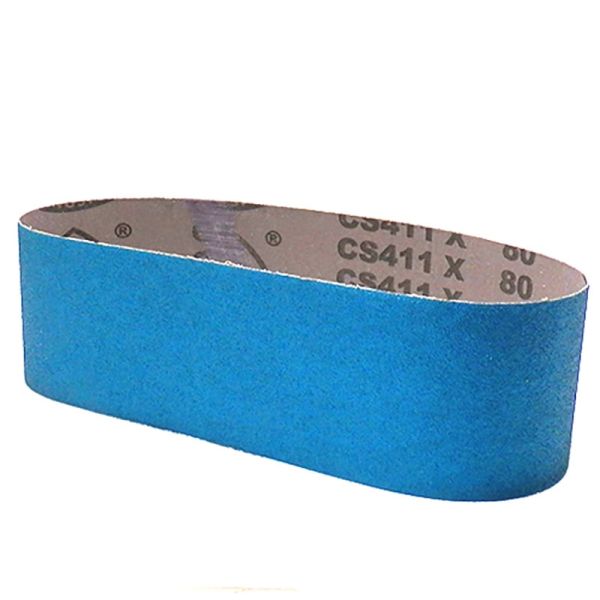

80 Grit Alumina Zirconia (Blue) Sanding, 3 in. Wide x 21 in. Long
Alumina Zirconia (Blue) Sanding / Planing Belt
These Alumina Zirconia sanding and planing belts are designed for demanding applications where fast cutting, long abrasive life, and heavy stock removal are essential. The sharp, durable zirconia grain performs especially well under high pressure, making these belts an excellent choice for dimensioning wood and aggressive grinding of hard metals.
They are well suited for grinding stainless steel, spring steel, titanium, and other hard steels. They can also be used for heavy stock removal and dimensioning of wood, plastic, rubber, glass, stone, and concrete products.
Product Specifications
- Grit: 80-Grit
- Size: 3 in. x 21 in.
- Abrasive Grain: Alumina Zirconia (Blue)
- Backing: YX Weight – lighter-weight polyester backing
- Coating: Closed Coat
- Bond: Resin-to-Resin
- Application: Wet or dry sanding
- Quantity: Sold individually
Alumina Zirconia (AZ)
Best for: Heavy stock removal, long belt life, and high-pressure sanding and grinding.
Alumina Zirconia (AZ) is a tough, high-performance abrasive grain engineered for demanding sanding and grinding applications. Its sharp cutting action and ability to renew cutting edges under pressure make it particularly effective when rapid material removal and extended abrasive life are important.
Unlike abrasives intended primarily for light-duty sanding, Alumina Zirconia performs best when sufficient machine pressure is applied. The pressure helps fracture the abrasive grain and expose fresh cutting edges, maintaining aggressive cutting performance. Insufficient pressure can cause the abrasive to glaze and reduce cutting efficiency.
- Top Uses: Wood planing, dimensioning, heavy metal grinding, stainless steel, hard steels, and other high-stock-removal applications
- Best Grit Range: Coarse grits, approximately 24–80, for aggressive material removal
- Why Choose AZ: Long abrasive life and fast cutting performance in high-load applications
Tip: Alumina Zirconia is optimized for machine sanding and grinding. For light sanding, finishing, or hand-sanding applications, a more flexible or fine-grit abrasive may be a better choice.
Cloth Backing
Choose the backing based on the required flexibility, durability, pressure, and application.
- J Weight – Light / Flexible:
Best for contours, curves, and detailed sanding where the abrasive needs to conform closely to the workpiece. - X Weight – Medium / General Purpose:
A versatile cloth backing suitable for a wide range of sanding applications on portable and stationary belt sanders. - Y Weight – Heavy Duty / Polyester:
Designed for aggressive grinding, flat surfaces, high-pressure applications, and demanding environments. Polyester backing provides excellent durability and resistance to heat and moisture.
Flex Options
- J-Flex (JF): Extra flexibility for tight curves, mold sanding, and other contoured applications.
- X-Flex (XF): Increased flexibility for slack-belt and applications requiring additional conformability.
Backing Selection Tips
- Choose J or JF for curved surfaces, contours, and detailed work.
- Choose X or XF for general-purpose sanding and applications requiring moderate flexibility.
- Choose Y or polyester for heavy grinding, flat surfaces, high pressure, and high-heat applications.
Water Resistance
- Cotton Backings (J & X): Generally not waterproof unless specifically identified as W/D or WP. Do not use with water unless the belt is designated for wet sanding.
- Polyester Backings (Y): Water-resistant and highly durable, making them well suited for wet sanding and demanding heavy-duty applications.
Quick Tip: For applications involving water, heavy pressure, or elevated temperatures, a polyester backing is generally the preferred choice for durability and performance.
Ideal Applications
- Heavy wood stock removal and dimensioning
- Wood planing and leveling
- Stainless steel grinding
- Spring steel and hard-steel grinding
- Titanium grinding
- Heavy-duty metal stock removal
- Plastic and rubber stock removal
- Glass, stone, and concrete product applications
With its 80-grit Alumina Zirconia abrasive, durable polyester backing, closed-coat construction, and resin-to-resin bond, this 3 in. x 21 in. belt is built for aggressive cutting and heavy-duty material removal where dependable abrasive performance matters.
| GRIT # or COARSENESS | 80 |
|---|---|
| BRAND | Klingspor |
| MATERIAL | Alumina-Zircona |
| WIDTH | 3 in. |
| LENGTH | 21 in. |
| QUANTITY | (1) Each |
| SKU | KP-321E |
| Prop 65 |
|
 Warning: Some dust that is created by power sanding, sawing, grinding, drilling, or other activities contains chemicals known to the State of California to cause cancer, congenital disabilities, or other reproductive issues. These chemicals include Lead from lead-based paints, crystalline silica from bricks, cement, and other masonry products, and arsenic from chemically treated lumber materials. Your risk from exposure to these chemicals varies, depending on how often you do this work. To reduce your exposure, work in a well-ventilated area and with approved safety equipment, such as dust masks and dust collection specifically designed to filter out microscopic particles. For more information go to www.P65Warnings.ca.gov/wood.
Login and Registration Form