

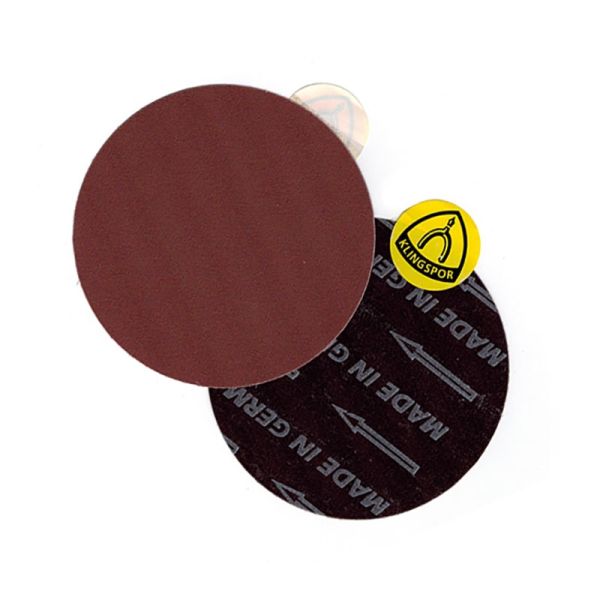

80 Grit Aluminum Oxide, 9 in. PSAdhesive Sanding Disc - Qty:5
80 Grit Aluminum Oxide, 9 in. Pressure Sensitive Adhesive Sanding Disc - QTY:5
Production Shops Take Note - No cheap materials used here!
Our PSA (pressure sensitive adhesive) discs are made of full resin-bonded aluminum oxide, heavy cloth-backed material, along with an adhesive that holds fast yet does not gum up your backing pad. Ideal for production situations that require discs to hold fast at high speeds and for repetitious, single-grit sanding of flat surfaces. Our competitors often use inferior materials or scrap in the manufacture of their discs. KLINGSPOR provides only high-quality industrial products. The broader grit range allows you to achieve the perfect finish every time. Each pre-glued disc attaches in seconds; peel off the backing paper, stick it on, and sand.
These discs are manufactured from our premium Aluminum Oxide material for wood sanding operations where clogging or loading is a problem. Also great for sanding soft metals such as brass or bronze.
Specifications:
- 80 Grit
- 9 in. Diameter
- Aluminum Oxide
- Anti-Static
- Resin to Resin bonded
- Heavy Y-weight polyester backing
- Open Coat
- Pack of 5
- Sticky back- PSA (pressure sensitive adhesive)
Aluminum Oxide (AO)
Aluminum Oxide is made by combining bauxite and other materials in an electric furnace. The resulting material is crushed, then sifted through progressively finer screens to determine grit size using CAMI grading. When crushed, the particles naturally form a pyramidal shape. Because of this shape and the strength of the material, Aluminum Oxide is a very durable abrasive grain. As it is used, the grain gradually wears down and continues to sand with a finer scratch pattern.
Aluminum Oxide is tough and durable, making it a great general-purpose grain. It is commonly used on bare wood, most metals, especially steel, leather, and many other materials. It is one of the most widely used abrasive grains available today.
Silicon Carbide (SC)
Silicon Carbide is made by combining pure white silica sand and coke, a by-product of coal production, in an electric furnace. The resulting material is crushed and sifted through screens to determine grit size. Silicon Carbide grains are shaped like sharp icicles, with narrow grain bodies and very sharp points.
Silicon Carbide is extremely hard, second only to diamond, but it is also brittle because of its narrow grain structure. When pressure is applied to the tip of the grain, it fractures. This property is called friability. The benefit of friability is that fresh, sharp edges are constantly exposed to the workpiece, providing a very consistent finish.
Because Silicon Carbide has less grain body strength than Aluminum Oxide and fractures more easily, it generally has a shorter life. For that reason, it is most often used in finishing applications where lighter pressure is required rather than heavy stock removal. Common materials sanded or ground with Silicon Carbide include glass, plastic, rubber, paint, varnish, lacquer, and sealers. It may occasionally be used on very soft woods like Ponderosa Pine, but open-coat Aluminum Oxide is usually recommended for longer life.
Cloth Backing
There are three basic weights of cloth backings: J, X, and Y. J and X backings are made from cotton. J-weight backing has a slight degree of conformability and is best used where the abrasive needs to flex slightly to match the workpiece. X-weight backing is a heavier cotton material and is considered an all-purpose backing used in a wide range of belt applications, including portable belts, intermediate belts, and wide belts.
Y-weight backings are made from 100% polyester, or in some cases, a 60/40 polyester-cotton blend. These are used for flat, heavy-duty sanding, dimensioning, high-heat applications, and rough sanding operations.
J- and X-weight backings are also available in more flexible versions called J-Flex (JF) and X-Flex (XF). These are ideal when standard J or X backing is not flexible enough. J-Flex is commonly used for pump sleeves and mold sanding belts, while X-Flex is mainly used for slack belt operations. Y-weight backings are not flexed, but they are available in lightweight polyester (YX) and heavyweight polyester (Y or YY). In general, coarser grits such as 24 through 50 or 60 use the heavier backing, while finer grits such as 80 through 120 use the lighter backing.
Semi-Open / Open Coat
The terms semi-open coat and open coat describe abrasives that have less grain coverage on the backing of the belt, sheet, or disc. A semi-open coat usually means about 30% less grain coverage, while an open coat usually means about 50% less grain coverage.
Because there is less abrasive grain on the surface, semi-open and open coat products cut less aggressively than closed-coat products. They also tend to leave a slightly coarser finish for the same grit rating.
The reduced grain coverage creates spaces between the abrasive particles, which helps reduce loading when sanding softer materials. However, those same gaps mean the finish will not be as uniform as a closed-coat product and will fall on the coarser end of that grit's normal finishing range.
| Product Group | Sanding Disc |
|---|---|
| Abrasive Diameter | 9 in. |
| ATTACHMENT METHOD | PSA Adhesive |
| SUCTION HOLES | 0 |
| GRIT # or COARSENESS | 80 |
| MATERIAL | Aluminum Oxide |
| BRAND | Klingspor |
| QUANTITY | 5-Pack |
| COAT | Open Coat |
| SKU | KD-0908 |
| SPECS: | |
| Prop 65 |
|
 Warning: Some dust that is created by power sanding, sawing, grinding, drilling, or other activities contains chemicals known to the State of California to cause cancer, congenital disabilities, or other reproductive issues. These chemicals include Lead from lead-based paints, crystalline silica from bricks, cement, and other masonry products, and arsenic from chemically treated lumber materials. Your risk from exposure to these chemicals varies, depending on how often you do this work. To reduce your exposure, work in a well-ventilated area and with approved safety equipment, such as dust masks and dust collection specifically designed to filter out microscopic particles. For more information go to www.P65Warnings.ca.gov/wood.
Login and Registration Form