

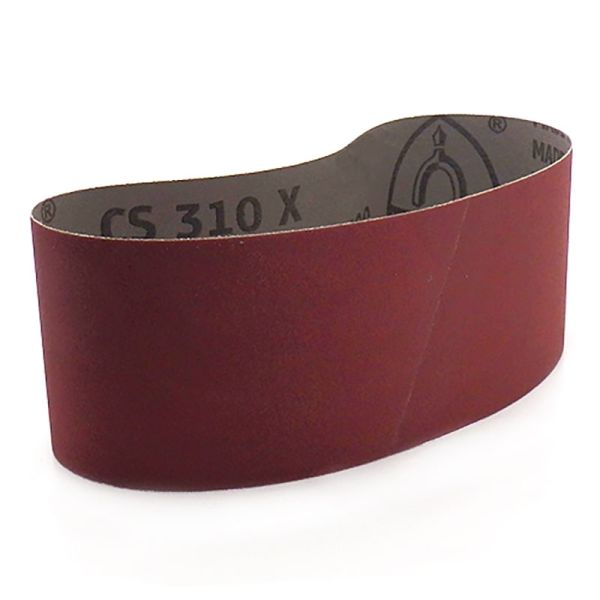

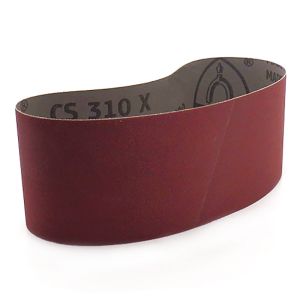
60 Grit Aluminum Oxide Sanding Belts, 3 in. Wide x 18 in. Long
60 Grit Aluminum Oxide, 3 in. x 18 in. Sanding Belt
These are Premium Abrasive Belts.
They are suitable for all ferrous metals, hardwoods, leather, aluminum, brass, bronze, stainless steel, and most alloys. You would use these belts where clogging or loading is a potential problem.
Specifications:
- Aluminum Oxide (blocky, hard grain)
- X-weight (a heavy, stiff Egyptian cotton cloth)
- Open Coat
- Resin to Resin bonded
- Anti-static to resist loading
- Sold per belt
Aluminum Oxide AO is formed by combining bauxite and other materials by firing them in an electric furnace. The resultant mass is then crushed, and the pieces are sifted through successively finer screens to assign a grit size (CAMI grading). When crushed, the resulting pieces are naturally pyramidal in shape. Due to the shape and the strength of the materials used in its making, AO is a very durable grain. The grain is worn down during use, sanding finer the longer it's used. So theoretically, you can start at 80 grit, and after you've worked the abrasive for a while, you'll sand more like 100 or 120 grit. Users take advantage of this characteristic by using the belts on multiple machines or applications. For instance, if you have two wide belt machines doing intermediate and finish sanding, respectively, you may use a 120 belt on the first machine to do your intermediate sanding. When the cut for that application is no longer as sharp, the belt can be moved to the 150-grit machine until the cut for that application is no longer sufficient. This ensures you get the most production and the full value for the belt you purchased.
As stated above,AO is very tough and durable and is used on bare wood, most metals (especially steel), leather, and various other materials. It is a great general-purpose grain and probably the most common grain seen today.
Cloth Backing There are three basic weights of cloth backings: J, X, and Y. J and X are cotton materials. The J has a slight degree of conformability and should be used where a small degree of conformability to the workpiece is needed in belts or sheets. The X is heavier-weight cotton and is an all-purpose/general-purpose backing used in various belting applications, including portable belts, intermediate belts, and wide belts. Y backings are 100% polyester (or, in some cases, a 60/40 poly/cotton split) and are used for flat, heavy-duty dimensioning or other high-heat or rough applications. The J and X weight backings have flexed versions available, referred to as J-Flex (JF) and X-Flex (XF). These would suit applications where the X or J is not quite flexible enough. The most common uses for JF backings are as pump sleeves and for mold sanding belts. The XF backings are used mainly for slack belt operations. The Y backings are not flexed but come in a lightweight poly (YX) and a heavyweight poly (Y or YY). Normally, 24-50 or 60 grits will be the heavier poly backing, and 80-120 will be the lighter poly backing.
| GRIT # or COARSENESS | 60 |
|---|---|
| BRAND | Klingspor |
| MATERIAL | Aluminum Oxide |
| WIDTH | 3 in. |
| LENGTH | 18 in. |
| QUANTITY | (1) Each |
| COAT | Closed Coat |
| SKU | KB-318D |
| Prop 65 |
|
 Warning: Some dust that is created by power sanding, sawing, grinding, drilling, or other activities contains chemicals known to the State of California to cause cancer, congenital disabilities, or other reproductive issues. These chemicals include Lead from lead-based paints, crystalline silica from bricks, cement, and other masonry products, and arsenic from chemically treated lumber materials. Your risk from exposure to these chemicals varies, depending on how often you do this work. To reduce your exposure, work in a well-ventilated area and with approved safety equipment, such as dust masks and dust collection specifically designed to filter out microscopic particles. For more information go to www.P65Warnings.ca.gov/wood.
Login and Registration Form