

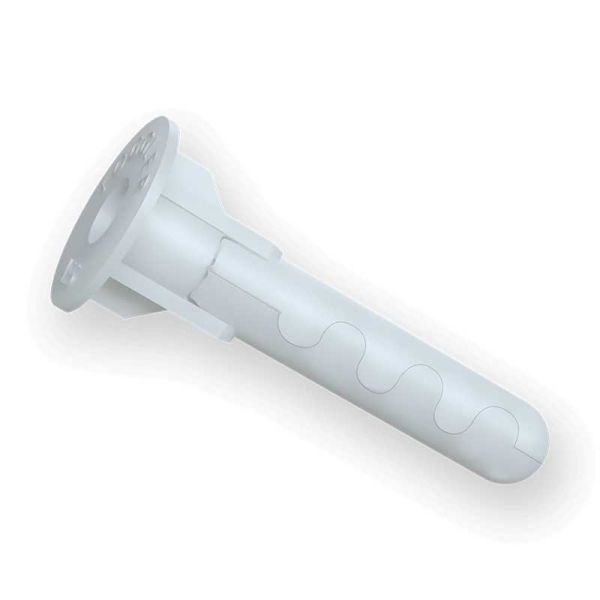


3/16 in. Flanged Alligator Anchors - QTY:200
High-Strength Anchoring for Solid and Hollow Materials
3/16-in. Flanged Alligator Anchors - QTY: 200
3/16-in. Flanged Alligator Anchors provide reliable, high-strength fastening in concrete, brick, stone, hollow block, drywall, and other challenging substrates. The specially formulated polypropylene anchor body expands and flows into imperfections and undercuts in the drilled hole, creating a secure mechanical bond while helping seal the hole against moisture.
The flanged design is ideal when a cavity may be encountered, including drywall, hollow brick, and hollow block. Unlike conventional plug-style anchors, Alligator Anchors can maintain strong holding power even when the wall material or drilled hole is less than perfect. They are also designed to resist vibration and shock while allowing screws to be removed and reinserted without sacrificing holding strength.
Strong, Versatile and Reliable
- High holding strength: Designed for demanding fastening applications in solid materials and can provide strong holding power with the appropriate screw and embedment depth.
- Works in multiple materials: Suitable for concrete, brick, stone, hollow walls, ceilings, and drywall applications.
- Secure screw-to-wall bond: The polypropylene body conforms to imperfections and undercuts in the hole to help lock the screw securely in place.
- Helps seal the hole: The anchor helps close the drilled opening and reduce moisture penetration.
- Flanged design: The integrated flange helps prevent the anchor from being pushed through the hole when installing in hollow materials.
- Anti-spin head: The uniquely shaped head helps prevent the anchor from spinning during installation and provides a clean, secure fit.
- Flexible screw compatibility: Accepts a broad range of screw sizes for added installation versatility.
- Forgiving installation: Maintains holding strength despite reasonable variations in screw size and drilled-hole diameter.
- Resists vibration and shock: Designed to provide dependable performance in applications subject to movement or impact.
- Reusable fastening: The screw can be removed and reinserted into the same anchor without losing its holding power.
- Corrosion resistant: The anchor is corrosion-proof when used with stainless steel screws.
- Fast setting: Sets instantly after installation for efficient fastening.
Solid Wall Installation
- Drill a hole into the wall using a drill bit with the same diameter as the anchor. The hole should be at least twice the length of the anchor.
- Push the Alligator Anchor into the hole and tap it flush with the wall using a hammer.
- Position the item being mounted over the anchor, insert the screw, and tighten it flush with the item. A screw gun is recommended for best results.
Hollow Wall Installation
- Drill a hole into the wall using a drill bit with the same diameter as the anchor.
- Push the flanged Alligator Anchor into the hole and tap it flush with the wall using a hammer.
- Position the item over the anchor, insert the screw, and tighten it securely until flush with the item.
With a combination of high holding strength, versatile material compatibility, vibration resistance, and easy installation, these 3/16-in. Flanged Alligator Anchors are a dependable choice for fastening projects where conventional wall anchors may not provide sufficient security.
| BRAND | Toggler |
|---|---|
| MATERIAL | Plastic |
| QUANTITY | LG (151-500) |
| SKU | ASW-05F-X |
| Prop 65 |
|
 WARNING: Drilling sawing sanding or machining wood products can expose you to wood dust a substance known to the State of California to cause cancer. Avoid inhaling wood dust or use a dust mask or other safeguards for personal protection. For more information go to www.P65Warnings.ca.gov/wood.
Login and Registration Form