

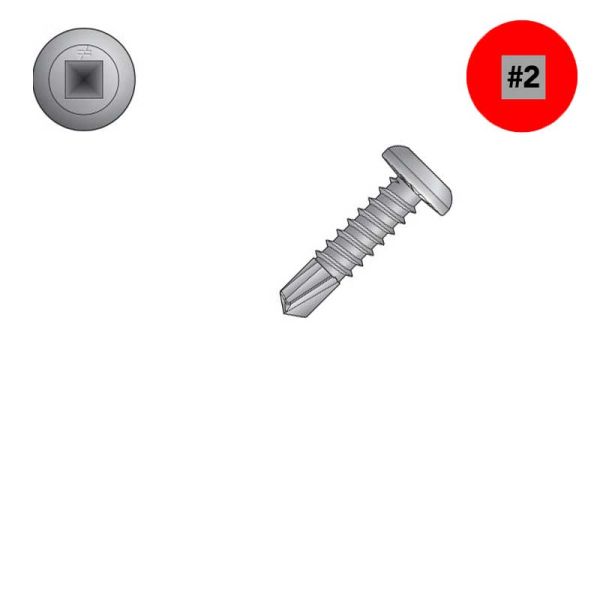



10 x 1-1/2 in. Self-Drilling,304/305 SS, Pan Head, Square - Qty:100
10 x 1-1/2 Self-Drilling, Stainless Pan Head, Square Drive Screws - Qty:100
If you work with fiberglass, man-made stone, composites, fiber cement board, or light gauge steel studs, you are really going to appreciate these screws when you need corrosion resistance. Until now, the only screws available had Phillips recesses, which forced a choice between corrosion resistance and drivability. Well, there is no need to settle anymore. These have a #2 self drilling point which when used with light gauge steel is designed for a total material thickness of .035 to .100. In softer materials like fiberglass the material thickness can be ignored.
| SIZE (#8, #10 ...) | #10 |
|---|---|
| LENGTH | 1-1/2 in. |
| MATERIAL | Stainless Steel, 304 & 305 |
| COUNTERSINK NIBS | Without Nibs |
| RECESS TYPE | Square |
| HEAD | Pan |
| POINT TYPE | Self Tapping Metal |
| BRAND | McFeely's |
| RECESS SIZE | #2 |
| QUANTITY | 100-Box |
| Head Diameter | 3/8 in. |
| RoHS Compliant? | No |
| SKU | 1014-PT5-C |
| Prop 65 | If you work with fiberglass, manmade stone, composites, fiber cement board, or light gauge steel studs, you are really going to appreciate these screws when you need corrosion resistance.Until now, the only screws available had Phillips recesses, which forced a choice between corrosion resistance and drivability. Well, there is no need to settle anymore. These have a #2 self drilling point which when used with light gauge steel is designed for a total material thickness of .035 to .100. in. softer materials like fiberglass the material thickness can be ignored. Key Features
Applications
Tapping Style Thread: Also known as "Type A" or "Wood Tapping," this is 'basically a sheet metal type thread. It is a single lead, fine thread design (meaning more threads per inch). Also, the thread form is basically an "equilateral" triangle, instead of 'the special "flattened" triangular thread which is used for "Deep" threads. Generally, the entire screw shank is threaded, which makes sense for a sheet metal screw, of course. Self Tapping Screws feature a self-drilling tip that drills through the steel and then the tapping screw thread locks itself into the steel. Make sure you use a slower rpm. and give the self-drilling point time to cut away the metal or softer material just like a drill bit Stainless Steel: No discussion of corrosion resistance would be complete without mention of stainless steel screws. Although all products corrode sooner or later, stainless steel continues to provide excellent protection. Stainless steel is a general term for a large group of alloy steel that contains at least 10.5% chromium. Since the carbon content of stainless is quite low, oxidation (rusting) is also quite low. However, since the carbon content is low, the steel cannot be hear treated to adequate levels. As a result the screws are soft and break easily when used in wood applications where high levels of torque strength are required. Pre-drilling all screw holes and using larger gauges of screws can compensate for this problem. The Nickel used in manufacturing Stainless Steel make them non-magnetic and will not hold to a magnetic bit. 18/8 grade stainless steel is one of two of the most common grades used in food preparation, dining and cookware. 18/8 stainless steel is comprised of 18% chromium and 8% nickel. 304 grade stainless steel is made up of no more than 0.8% carbon and has at least 50% iron. The chromium is what binds oxygen to the surface of the product to protect the iron from rust (oxidation). Nickel also enhances the corrosion resistance of stainless steel. The higher the nickel content, the more resistant the stainless steel is to corrosion. The second most popular type of stainless is Type 316. 316 stainless lowers the chromium content from 18% to 16%, and the nickel content is increased to 10% and 2% molybdenum is added to the mixture. The change in the chromium/nickel ratio along with the addition of the molybdenum increases the resistance to chlorides. This is why Type 316 stainless is recommended in more corrosive environments, such as oceanside and pools where the material will be exposed to chemical, solvent, or salt water corrosion. This makes it the preferred material for marine construction. |
If you work with fiberglass, manmade stone, composites, fiber cement board, or light gauge steel studs, you are really going to appreciate these screws when you need corrosion resistance.
Until now, the only screws available had Phillips recesses, which forced a choice between corrosion resistance and drivability. Well, there is no need to settle anymore. These have a #2 self drilling point which when used with light gauge steel is designed for a total material thickness of .035 to .100. in. softer materials like fiberglass the material thickness can be ignored.
Key Features
- Fully threaded
- #3 drill point
- #2 square drive
Applications
- Aluminum and fiberglass fastening (not steel)
Tapping Style Thread: Also known as "Type A" or "Wood Tapping," this is 'basically a sheet metal type thread. It is a single lead, fine thread design (meaning more threads per inch). Also, the thread form is basically an "equilateral" triangle, instead of 'the special "flattened" triangular thread which is used for "Deep" threads. Generally, the entire screw shank is threaded, which makes sense for a sheet metal screw, of course.
Self Tapping Screws feature a self-drilling tip that drills through the steel and then the tapping screw thread locks itself into the steel. Make sure you use a slower rpm. and give the self-drilling point time to cut away the metal or softer material just like a drill bit
Stainless Steel: No discussion of corrosion resistance would be complete without mention of stainless steel screws. Although all products corrode sooner or later, stainless steel continues to provide excellent protection. Stainless steel is a general term for a large group of alloy steel that contains at least 10.5% chromium. Since the carbon content of stainless is quite low, oxidation (rusting) is also quite low. However, since the carbon content is low, the steel cannot be hear treated to adequate levels. As a result the screws are soft and break easily when used in wood applications where high levels of torque strength are required. Pre-drilling all screw holes and using larger gauges of screws can compensate for this problem.
The Nickel used in manufacturing Stainless Steel make them non-magnetic and will not hold to a magnetic bit.
18/8 grade stainless steel is one of two of the most common grades used in food preparation, dining and cookware. 18/8 stainless steel is comprised of 18% chromium and 8% nickel. 304 grade stainless steel is made up of no more than 0.8% carbon and has at least 50% iron. The chromium is what binds oxygen to the surface of the product to protect the iron from rust (oxidation). Nickel also enhances the corrosion resistance of stainless steel. The higher the nickel content, the more resistant the stainless steel is to corrosion.
The second most popular type of stainless is Type 316. 316 stainless lowers the chromium content from 18% to 16%, and the nickel content is increased to 10% and 2% molybdenum is added to the mixture. The change in the chromium/nickel ratio along with the addition of the molybdenum increases the resistance to chlorides. This is why Type 316 stainless is recommended in more corrosive environments, such as oceanside and pools where the material will be exposed to chemical, solvent, or salt water corrosion. This makes it the preferred material for marine construction.
Login and Registration Form