

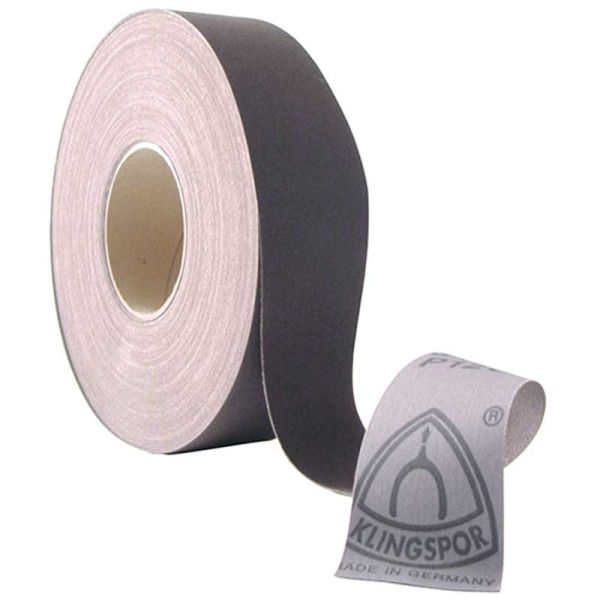

1 in. X 50 Yd. Shop Roll, 180 Grit
1 in. X 50 Yd. Shop Roll, 180 Grit
Whether you're a turner, a carver, or need to sand that certain little spot, you'll be raving too if you try these Shop Rolls
This long-lasting, cloth-backed, aluminum oxide material from KLINGSPOR'S ABRASIVES is specially woven to be extremely flexible yet get you through those situations when you must fold, crimp, and twist your sandpaper to the desired shape.
Aluminum Oxide AO is formed by combining bauxite and other materials by firing them in an electric furnace. The resultant mass is then crushed, and the pieces sifted through successively finer screens to assign a grit size (CAMI grading). When crushed, the resulting pieces are naturally pyramidal in shape. Due to the shape and the strength of the materials used in its making, AO is a very durable grain. The grain is worn down during use, sanding finer the longer it's used. Users take advantage of this characteristic by using the belts on more than one machine (belt sanders or drum sanders) or application. For instance, if you have two wide belt machines doing intermediate and finish sanding respectively, you may use a 120 sanding belt on the first machine to do your intermediate sanding. When the cut for that application is no longer as sharp, the sanding belt can be moved to the 150 grit machine and used there till the cut for that application is no longer sufficient. This ensures you get the most production and the full value for the belt you purchased.
AO is very tough and durable, as stated above, and is used on bare wood, most metals (especially the steels), leather, and a wide variety of other materials. It is a great general-purpose grain and probably the most common grain seen today.
Cloth Backing
The J Cloth Backing has a slight degree of conformability to it and should be used where a small degree of conformability to the workpiece is needed in belts or sheets. The J weight backings have flexed versions available that are referred to as J-Flex (JF). These would be suitable for applications where J is not quite flexible enough. The most common uses for JF backings are as pump sleeves and for mold sanding belts.
No cotton backings are naturally waterproof. They may be chemically treated to be waterproof, however. If this has occurred, the backing should say waterproof or be marked as W/D or WP. If you do not see such a marking on the back of a cotton belt, do not run with water or the backing will stretch.
With the advent of the synthetic resins, the productivity and life of abrasives were greatly enhanced. Resin bonds are phenolic and therefore offer the grain excellent protection from heat, which in turn extends life. Most of the abrasives in use today are resin bonded. When you do encounter glue-bonded items, they usually fall into the "finishing" category of products, as that's where the workload is the lightest, and the softer scratch is most important.
| Product Group | Sanding Rolls |
|---|---|
| GRIT # or COARSENESS | 180 |
| BRAND | Klingspor |
| MATERIAL | Aluminum Oxide |
| WIDTH | 1 in. |
| QUANTITY | (1) Each |
| COAT | Closed Coat |
| SKU | KR-361H |
| SPECS: |
|
| Prop 65 |
|
 Warning: Some dust that is created by power sanding, sawing, grinding, drilling, or other activities contains chemicals known to the State of California to cause cancer, congenital disabilities, or other reproductive issues. These chemicals include Lead from lead-based paints, crystalline silica from bricks, cement, and other masonry products, and arsenic from chemically treated lumber materials. Your risk from exposure to these chemicals varies, depending on how often you do this work. To reduce your exposure, work in a well-ventilated area and with approved safety equipment, such as dust masks and dust collection specifically designed to filter out microscopic particles. For more information go to www.P65Warnings.ca.gov/wood.
Login and Registration Form