

Drawer Slide Replacement Buyers Guide
Drawer Slides are an integral part of any home. Slides can become damaged over time, and your drawers or pull-outs do not work well. It could be simply rust or damage from use. They become a source of frustration, but replacing your Drawer Slides is easy and cheap, once you know how to pick the right Drawer Slide
The process of selecting the right slide, glide, or runner, in order of importance. Types, Measurements, Mounting, Weight Considerations, Extensions, Disconnects, and Features.
Jump to:
Types of Slides
A wide variety of slides are available for face frame and frameless applications. Includes bottom mount and side mount.
Standard roller drawer slides for kitchen, commercial, and furniture applications.
We offer Grass Slides because they offer a variety of roller drawer slides to satisfy the needs of more traditional cabinetry applications. From a standard roller slide to a ball bearing slide, Grass can cover most applications with various load capacity ratings, guaranteeing the highest quality product. Drawer slides from Grass are known for their self-closing action, premium quality, side stability, and various sockets to meet your application needs.
Epoxy Coated Roller slides: Tried-and-tested quality and functionality. Side-mounted with a bottom lip for easy location. These slides have a 75 lb. load rating and are usually not full extension slides.
Side Mounted Ball Bearing Drawer Slides have a higher load rating and can be partial or full extension.
DYNAPRO Slide System Efficient. Effective. Concealed. Dynapro under-mount slides for wood drawers and Vionaro drawers combine intelligent features plus superb gliding action for today’s modern cabinetry.
Back to the Top

Slide Measurements
The most important feature when selecting a drawer slide is its physical size. Drawer slides are measured by Length, Depth, and Height.
The Drawer Slide's Depth is also called the thickness; this measurement is the starting point for finding the right slide. A drawer slide that is too thick or too thin is difficult to install and will prevent your drawer slide from working. It is better to have one that is too thin than too thick. If it is too thin, you can use some shims to space out the mount to make it fit. If it's too thick, you have to decrease the size of your drawer box.
The two ways to measure are to take the old one out or by application. Taking out the old one is straightforward: measure it and inspect the mounting to be certain it fits your application. When you measure the cabinetry to find the sizes you'll need, you'll need to get the measurements from the right places. Remember, it is always best to buy a slide that is too thin because it is possible to put a shim between the slides and cabinet walls to make up the difference.
The Length of your Drawer Slide will make the slide work the way you want. A drawer slide that is too long or too short will not only prevent your drawer from opening and closing properly, but also. You should always use the longest slide possible for your application, which will fit the cabinet depth.
The Height of a Drawer Slide is a very uncommon limiting factor. You can't install a slide that is taller than your drawer or pull-out. A silverware drawer may not be tall enough to fit a heavy-duty drawer slide. If you're planning on mounting thin drawers or pull-outs with a short mounting space height, make sure you're picking the drawer slide with the right height.
The Recommended Drawer Width is an important specification that ensures that your drawer slides don't twist and flex too much, which can easily cause damage and reduce the slide's life span. While a Recommended Drawer Width is not a hard limit, wider drawers should carry significantly less weight than their specified Weight Capacity. Many slides don't have a specific measure, but are not intended for lateral file drawers, which means that the drawer's width shouldn't exceed its depth into the cabinet.
Back to the Top
Mounting Types
The Mounting Type describes where the drawer slide attaches to the cabinet and Drawer. Slides can be mounted in different ways. Some slides feature accessory brackets to adapt them to different mounting types.
Side Mounted- This is the most common type of slide. It attaches to both the side of the Drawer and the side of the inner cabinet. This type of mounting is very efficient at carrying weight, and usually requires no modification to the drawer box.
Center Mount- One of the oldest types of slides, mounted on the Drawer's bottom, along the center. Center Mount is usually only a single wood rail. This makes them an option when on a budget, but they have a lower weight capacity. Center mounting is the best option when there is no gap between the drawer walls and the cabinet.
Under / Bottom Mount- attaches to the bottom of a drawer and to the side of the Drawer. This supports the Drawer from the bottom, which is useful when side or top space is limited, found in applications like Electronics. This type of mount is to conceal drawer slides below the Drawer and out of sight.
Top Mounted- This type of slide is useful for pull-out surfaces, and is common in tray applications. The drawer slide attaches to a surface above the Drawer and attaches to the top edge or side of the pull-out.
Back to the Top
Weight Capacity Considerations
Drawer Slides are designed to be used close to their weight rating. Overloading causes damage by putting extra stress on the slide. Under loads can also cause damage. Slides are designed to flex; underweight individuals will have alignment issues. They will last longer at their ideal weight.
Back to the Top
Required Clearance
The space around the drawer box that a slide needs to mount and work. To attach slides to your drawer box, it must be a little smaller than the cabinet cubby it fits into. The drawer front does not slide inside the cabinet; always measure the box, not the front.
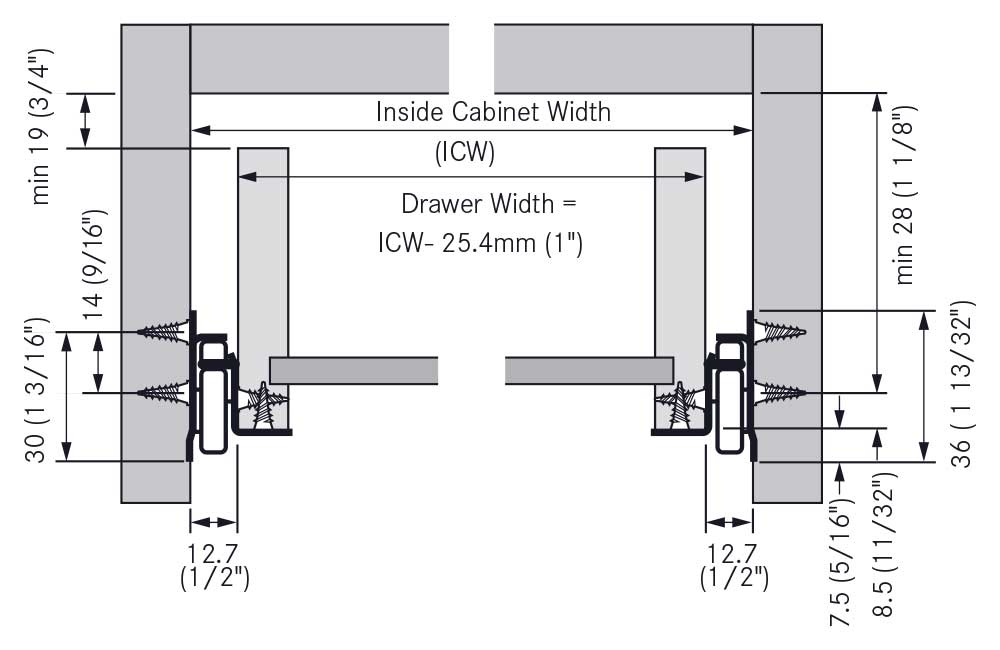
This image shows a large Horizontal clearance and a smaller vertical clearance. In most types of cabinetry, these gaps are hidden by the drawer face. When we make measurements for drawer slides, the drawer face is ignored.
Side / Horizontal / Width Clearance is the difference between the Cabinet Opening Width and the Drawer Box Width. Measure from the outside, left to right, of the drawer box walls.
Vertical / Height Clearance is the Opening minus the Drawer Box. Many applications have more than one Drawer. Add up the total TOP and BOTTOM clearance with each Drawer and the total to make sure your design works.
Depth / Clearance is the distance from the back of the drawer box to the rear cabinet wall when the Drawer is closed. Measure from the inside of the drawer face to the outside of the back drawer wall.
Measuring Clearance:
To measure the horizontal clearance of a cabinet system, take the width of the cabinet hole and subtract the width of the drawer box, as shown below. The process is the same for Vertical and Depth Clearance.
Slide Extension Types
Drawer Slides come in two basic types of extensions: 3/4 Extension and Full Extension
3/4 Extension Slides are partial and are very useful for most applications. The slide will extend 3/4 drawer outwards. The back 1/4 of the Drawer will remain inside the cabinet.
Full Extension Drawer Slides will pull your Drawer till the back wall of the Drawer is flush with the cabinet face, the full length of the slide. This allows you full access to all of your drawers' contents with ease.
Back to the Top
Drawer Slide Features
There are several features that can add some character to your home.
Soft Close- Soft Close drawer slides will slow down your Drawer as it closes, ensuring that it won't slam.
Self-Close- This drawer slide will pull your Drawer closed when you gently press it. This feature with heavy loads is not always gentle. Choosing this type of slide for anything fragile or loud can be an issue.
There are so many types of kitchens, closets, and types of furniture that we want with slides, from different mounting styles to the options that are more about how long they will last, stainless, coated, epoxy, roller bearings, sealed bearings, colors, and locks.
Progressive Movement- For Full Extension and Over Travel Slides, progressive movement improves upon the normal slide to provide a smoother rolling motion. Instead of having each sliding element bump into and catch the next as the Drawer opens or closes, all of the sliding members move at once.

Login and Registration Form